Base Layer vs CeraVe: Which Moisturizer Is Right for You?
By Sam Doyle, Founder, Base Layer
Key Takeaways
You've probably heard of CeraVe. It's the moisturizer that's everywhere—drugstore shelves, dermatologist recommendations, Reddit threads about skincare. It works. It's cheap. And it's a solid choice if you want a basic, no-frills moisturizer.
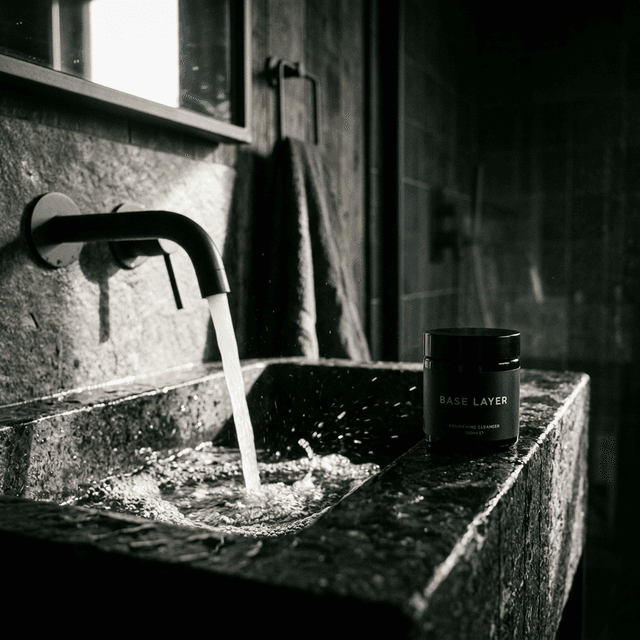
Let's get this out of the way: CeraVe is a good moisturizer. It's not a gimmick. It's not overrated. The ceramide-based formula genuinely repairs your skin barrier, and at roughly $16 a bottle, it's one of the best value propositions in skincare. If someone asks me what to use and they've never had a routine before, CeraVe is a perfectly reasonable starting point.
But starting points aren't finishing points. And if you're reading this, you're probably past the starting line. You want to know whether it's worth paying more for something that does more — or whether CeraVe already has you covered. I'm going to break this down honestly, because I think you deserve better than a sales pitch disguised as a comparison.
By Sam Doyle, Founder, Base Layer
Who CeraVe Is Best For
CeraVe built its reputation on a simple, effective formula: three essential ceramides, cholesterol, and fatty acids delivered through a patented MVE technology that releases moisturizing ingredients over time. It's the kind of product a dermatologist recommends when your skin is angry, compromised, or just needs to calm down. And that recommendation is earned.
If you're on a tight budget and need a moisturizer that works without irritation, CeraVe is hard to beat. If your skin barrier is wrecked from over-exfoliating, retinol overuse, or harsh cleansers, CeraVe's ceramide complex is exactly what you need to stabilize things. It doesn't try to do too much. It does one thing — barrier repair — and it does it well.
It's also an excellent choice if you have genuinely sensitive or reactive skin. CeraVe's formula is deliberately minimal. No fragrance. No actives that might trigger a response. For someone whose primary goal is "stop my skin from freaking out," that minimalism is a feature, not a limitation.
The Ceiling on Basic Barrier Repair
Here's where the honest part begins. CeraVe is a barrier repair moisturizer. That's its entire job. And once your barrier is intact — once your skin isn't dry, flaky, or irritated — CeraVe has effectively maxed out what it can do for you. It maintains. It protects. But it doesn't build.
CeraVe contains no anti-aging actives. No peptides stimulating collagen synthesis. No niacinamide at a concentration that meaningfully regulates sebum or fades hyperpigmentation. If those concerns are on your radar — and if you're a man in your late twenties or older, they should be — CeraVe isn't addressing them.
CeraVe is defensive skincare. It prevents damage, prevents moisture loss, prevents irritation. What it doesn't do is play offense. It won't reduce pores. It won't stimulate collagen. It won't regulate the oil production that leaves your face slick by noon.
And that's where layering gets complicated. A niacinamide serum. A peptide treatment. An eye cream. Suddenly your "simple" routine is three or four products deep, and that $16 price tag looks different when you factor in everything else.
What Base Layer Adds to the Equation
I built Base Layer because I got tired of the choice between "basic moisturizer that does nothing interesting" and "twelve-step routine that no guy is actually going to follow." The goal: put clinically effective concentrations of treatment-grade actives into a single moisturizer.
Niacinamide (5%) — Vitamin B3 at the concentration most supported by clinical research. Visibly reduces pore size, regulates sebum, fades hyperpigmentation, strengthens the barrier. CeraVe contains niacinamide at a lower, undisclosed concentration — likely below the 5% clinical threshold.
Copper Peptide GHK-Cu — A naturally occurring peptide in human plasma that declines with age. Stimulates collagen synthesis, promotes wound healing, supports skin remodeling. The kind of ingredient you typically find in $80-$150 serums.
Squalane — Lightweight, plant-derived lipid that mirrors your skin's natural sebum. Deep hydration without clogging pores or greasy residue. Where CeraVe uses heavier occlusives, squalane absorbs fully into the lipid matrix.
Panthenol (Pro-Vitamin B5) — Deeply hydrates, reduces transepidermal water loss, accelerates repair. Especially effective for post-shave irritation — something most men deal with daily but few moisturizers address.
Centella Asiatica — Contains madecassoside, asiaticoside, and asiatic acid. Reduces inflammation, promotes collagen synthesis, accelerates wound healing. Heavy lifting for redness, razor burn, and irritation.
Hyaluronic Acid — Holds up to 1,000x its weight in water. CeraVe also uses it. The difference is what surrounds it.
The net effect: Base Layer functions as a moisturizer, treatment serum, and eye cream in a single product. One step. No layering.
Texture, Finish, and Daily Use
CeraVe Moisturizing Cream is thick and heavy. For nighttime use or very dry skin, the density is a benefit. For daily wear, it can feel greasy. Many men report a shiny finish that takes a while to absorb.
Base Layer was formulated for men's skin — thicker, oilier, more prone to clogged pores. Lightweight texture, absorbs in under 30 seconds, dries to a matte invisible finish. No shine, no residue, no tacky feeling. Works under facial hair without clogging follicles.
Post-shave is another differentiator. CeraVe can sting on freshly shaved skin. Base Layer's panthenol and centella asiatica are specifically designed to soothe post-shave irritation.
Cost Per Year: The Real Math
CeraVe alone: $96-$128/year (6-8 bottles at $16). Barrier repair and hydration only.
CeraVe + serums + eye cream: $181-$298/year. Full functionality, but 3-4 products layered in sequence.
Base Layer: $228-$304/year (6-8 bottles at $38). Full functionality in one product. One step.
When you compare the same level of actives and benefits, Base Layer is price-competitive with a multi-product CeraVe routine. The difference is consolidation and simplicity.
If you genuinely only need barrier repair — if your concerns begin and end with dryness — CeraVe at $96-$128/year is the smarter buy.
The Bottom Line
CeraVe is a legitimately good product. If you're starting from zero, if your budget is locked, or if your skin just needs to be left alone and hydrated, CeraVe is the right call.
Base Layer is a moisturizer that also treats. Niacinamide for oil control, copper peptides for collagen, squalane for barrier support, panthenol for post-shave recovery, centella for inflammation, hyaluronic acid for hydration. All in one product that absorbs in 30 seconds and dries matte.
The question isn't "which moisturizer is better." It's "what do you want your moisturizer to do?"
If the answer is "keep my skin from being dry" — CeraVe. Save your money.
If the answer is "keep my skin from being dry, reduce my pores, control oil, fight fine lines, support collagen production, calm post-shave irritation, and replace three products with one" — that's what I built Base Layer to do.
You Might Also Like
Base Layer vs Caldera Lab: Disclosed Actives or Botanical Luxury?
Caldera Lab sells a $65 moisturizer called The Base Layer. We're the other Base Layer. Here's an honest ingredient-by-ingredient comparison with real prices.
Chlorine, Cumulative UV Exposure, and the Muscle-Skin Barrier Trade-Off
Stop letting chlorine, 100-mile winds, and severe UV exposure destroy your skin barrier. Base Layer's no-nonsense recovery guide for triathletes.
The Golfer's Skin Strategy: Managing 4-5 Hour Sustained UV, Wind Dehydration, and Hat-Line Pressure Marks
Stop baking deep wrinkles into your face. Reverse 5 hours of fairway sun damage and pesticide exposure with this targeted routine.
Best Moisturizer for Acne-Prone Skin Men (2025 Guide)
FAQs
Reviewed by the Base Layer skincare team. Based on published dermatological research and clinical ingredient data.