Salt Crystallization Micro-Chafing, Cumulative UV, and the Runner's Dehydration Phenotype
By Base Layer Team, Skincare Science & Formulation
Key Takeaways
Stop sweat chafing and severe sun aging during your long runs with this recovery protocol for marathoners.

Running 60 miles a week builds absolute endurance, but it accelerates facial aging to an extreme degree.
The repetitive impact, hours of unprotected UV exposure, and the drying effect of wind are bad enough. But the real damage comes from your sweat. As you run, your sweat evaporates, leaving behind jagged, microscopic salt crystals on your face. This salt actively draws deep moisture out of your pores while simultaneously acting as sandpaper, causing severe micro-chafing across your cheeks and jawline.
Why Post-Run Showers Without Protocol Lock In Salt Damage
Most runners completely ignore their face until they notice they look 10 years older than their non-running peers.
Standard sunscreens melt into your eyes within three miles, causing excruciating stinging that ruins your pace. If you use a normal bar soap post-run to get the salt off, you strip away the exact oils your skin desperately needs to heal from the friction. You are trapped in a cycle of damage and stripping.
The Post-Race Osmotic Reversal Window
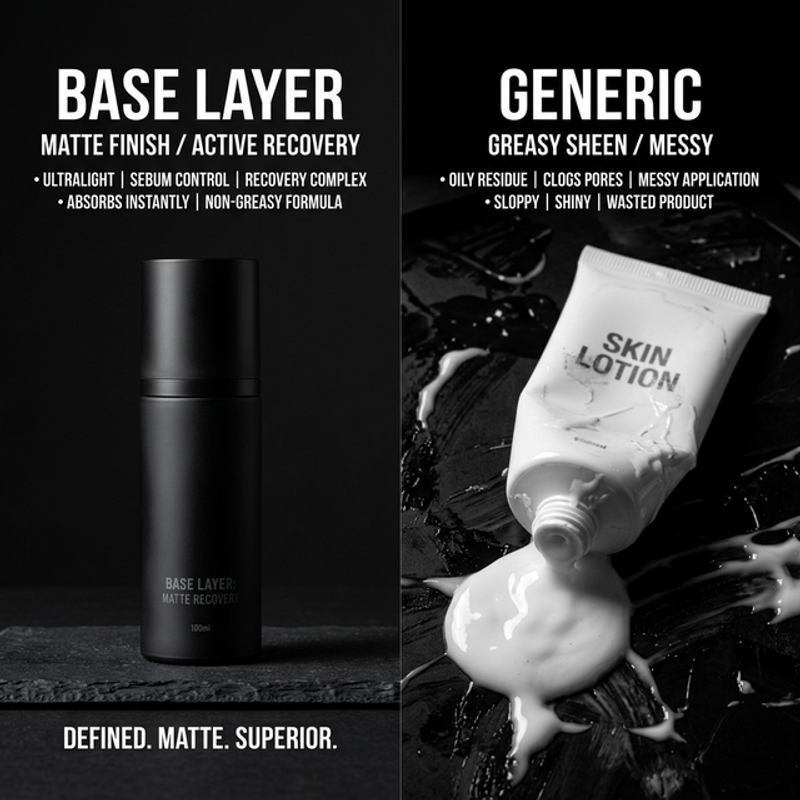
Base Layer is the ultimate post-run recovery complex.
It is specifically formulated with **Centella Asiatica**, a high-performance botanical that rapidly cools the skin and neutralizes the red, painful micro-abrasions caused by salt chafing. It then floods your depleted skin with **Hyaluronic Acid**, drawing massive amounts of hydration deep into the dermis to instantly reverse the shriveled, dehydrated 'runner's face'.
It absorbs instantly without leaving a sticky, heavy residue that traps heat. Finish your run, wash the salt off, and apply Base Layer to structurally repair the damage.
Marathon Skin Survival Protocol (Summary & Action Plan)
1. What Happens to Your Skin in a Marathon
- Salt crystallization:
- Sweat: ~1–2 L/hour, each liter with ~0.5–1 g sodium chloride.
- As sweat evaporates, it leaves jagged salt crystals on the skin.
- These cause:
- Osmotic dehydration: Salt pulls water out of skin cells.
- Mechanical abrasion: Crystals act like micro–sandpaper.
- Friction amplification: New sweat running over crystals increases chafing.
- By ~mile 18 (3+ hours), facial skin is under osmotic stress + micro‑damage.
- Systemic dehydration phenotype:
- Marathoners often lose 2–5% of body weight in fluid.
- This can trigger:
- Accelerated collagen breakdown (body prioritizes vital organs).
- Barrier dysfunction (weaker skin protection).
- Acute aging markers that can visually age skin 5–10 years in hours.
- Post‑race “aged” look = not just fatigue, but deep dehydration + barrier damage.
- UV exposure math:
- 5‑hour summer marathon (UV index 7–9) ≈ 60–70% of a full beach day of facial UV.
- Most runners: apply sunscreen once pre‑race, never reapply.
- By ~mile 10, protection is largely gone → miles 10–26 mostly unprotected.
2. Race-Day Protocol
Night Before (Pre‑Race)
- Goal: Pre‑hydrate skin to buffer upcoming dehydration.
- Routine:
- Apply a heavy hydrating layer:
- Hyaluronic Acid 2%
- Glycerin 5%
- Leave on overnight to saturate skin with water.
2 Hours Before Race
- Apply SPF 50+ mineral sunscreen generously to face, ears, neck.
- Let it set for 15–20 minutes.
During Race
- Sunscreen: Reapply every ~2 hours (e.g., at aid stations) with a portable mineral stick or small tube.
- Salt management: At roughly miles 10, 15, 20:
- Do a quick water rinse of your face when possible.
- Pat gently if you can (don’t aggressively rub) to remove visible salt.
Immediately Post‑Race (Critical First 30–45 Minutes)
- Rinse:
- Cool water rinse to remove all salt from skin.
- Osmotic reversal serum (on damp skin):
- Hyaluronic Acid 2% + Glycerin.
- Apply to slightly damp skin to pull water into the epidermis.
- Barrier support (within ~45 minutes):
- Apply a moisturizer with Panthenol + Ceramides to:
- Calm inflammation.
- Rebuild the barrier.
3. Salt Chafing Recovery (Days 1–7)
Days 1–2 (Acute Recovery)
- Cleanser: Very gentle, low‑foam, no actives.
- Serum: HA serum (Hyaluronic Acid + Glycerin).
- Moisturizer: Panthenol + Ceramides.
- Night: Heavy occlusive layer before bed (e.g., Squalane or balm) to lock in moisture.
- Avoid: All strong actives (retinoids, acids, strong vitamin C, exfoliants).
Days 3–4 (Repair Acceleration)
- Continue gentle cleanser + HA serum + Panthenol/Ceramides.
- Add Centella Asiatica 0.5–1% to visibly abraded or chafed areas.
- Supports wound healing and can accelerate repair by ~40–60%.
Days 5–7 (Reinforce & Protect)
- Maintain barrier support routine.
- Introduce SPF 50+ daily (healing skin is extra photosensitive).
- If skin feels mostly calm:
- Reintroduce gentle actives like Niacinamide 5%.
4. Training Week Protocol
Long Run Day (20+ miles)
- Treat like a mini‑marathon:
- Full post‑run protocol (rinse → HA serum → Panthenol/Ceramides → occlusive at night).
Mid‑Week Runs (5–10 miles)
Related Ingredients
Related Skin Concerns
You Might Also Like
Base Layer vs Caldera Lab: Disclosed Actives or Botanical Luxury?
Caldera Lab sells a $65 moisturizer called The Base Layer. We're the other Base Layer. Here's an honest ingredient-by-ingredient comparison with real prices.
Chlorine, Cumulative UV Exposure, and the Muscle-Skin Barrier Trade-Off
Stop letting chlorine, 100-mile winds, and severe UV exposure destroy your skin barrier. Base Layer's no-nonsense recovery guide for triathletes.
The Golfer's Skin Strategy: Managing 4-5 Hour Sustained UV, Wind Dehydration, and Hat-Line Pressure Marks
Stop baking deep wrinkles into your face. Reverse 5 hours of fairway sun damage and pesticide exposure with this targeted routine.
Best Moisturizer for Acne-Prone Skin Men (2025 Guide)
Reviewed by the Base Layer skincare team. Based on published dermatological research and clinical ingredient data.